Budget season has a way of turning into a list of subscriptions to renew rather than a plan for what should actually change. For most firms running on a calendar fiscal year, that season lands in Q4, with planning ramping up as early as September and locking in before January. Most firms can name their legal tech spend down to the dollar and still can't say which line item is actually paying back. That's a mapping problem, and it's fixable before this year's budget gets signed off.
In this article, we break down what the data actually shows about how law firms budget for technology, a framework for mapping specific tech spend to specific operational gaps, and where tools like CallConnector.ai and practice management software fit into that budget.
Why Do Some Legal Tech Purchases Pay Back and Others Don't?
A legal tech purchase pays back when it closes a specific, measurable gap in how the firm already operates, not because it's newer or more automated than what it replaces. Firms that treat budget season as a feature comparison exercise end up funding tools that sound impressive but don't move any number the firm actually tracks.
The fix is to choose spend based on which operational gap it closes, then check the number afterward to confirm it moved. That's a different exercise than reading a vendor's feature list.
What the Data Actually Says About Law Firm Technology Budgets
Most firms already have a technology budget, and most are growing it; the harder question is whether that money is mapped to anything measurable. According to the ABA's 2024 Legal Technology Survey, 65.2% of law firms budget for technology, though solo practitioners lag noticeably at 44.6%. Among firms that do budget, 53.7% increased that budget compared to the prior year.
Notably, the ABA found staff feedback is the single most influential factor in technology purchasing decisions, more so than vendor advertising or industry rankings. That matters for budget season specifically: the people using a tool daily are better positioned to say whether it closed a real gap than any feature comparison ever will.
The Four Gaps Where Legal Tech Spend Actually Shows Up
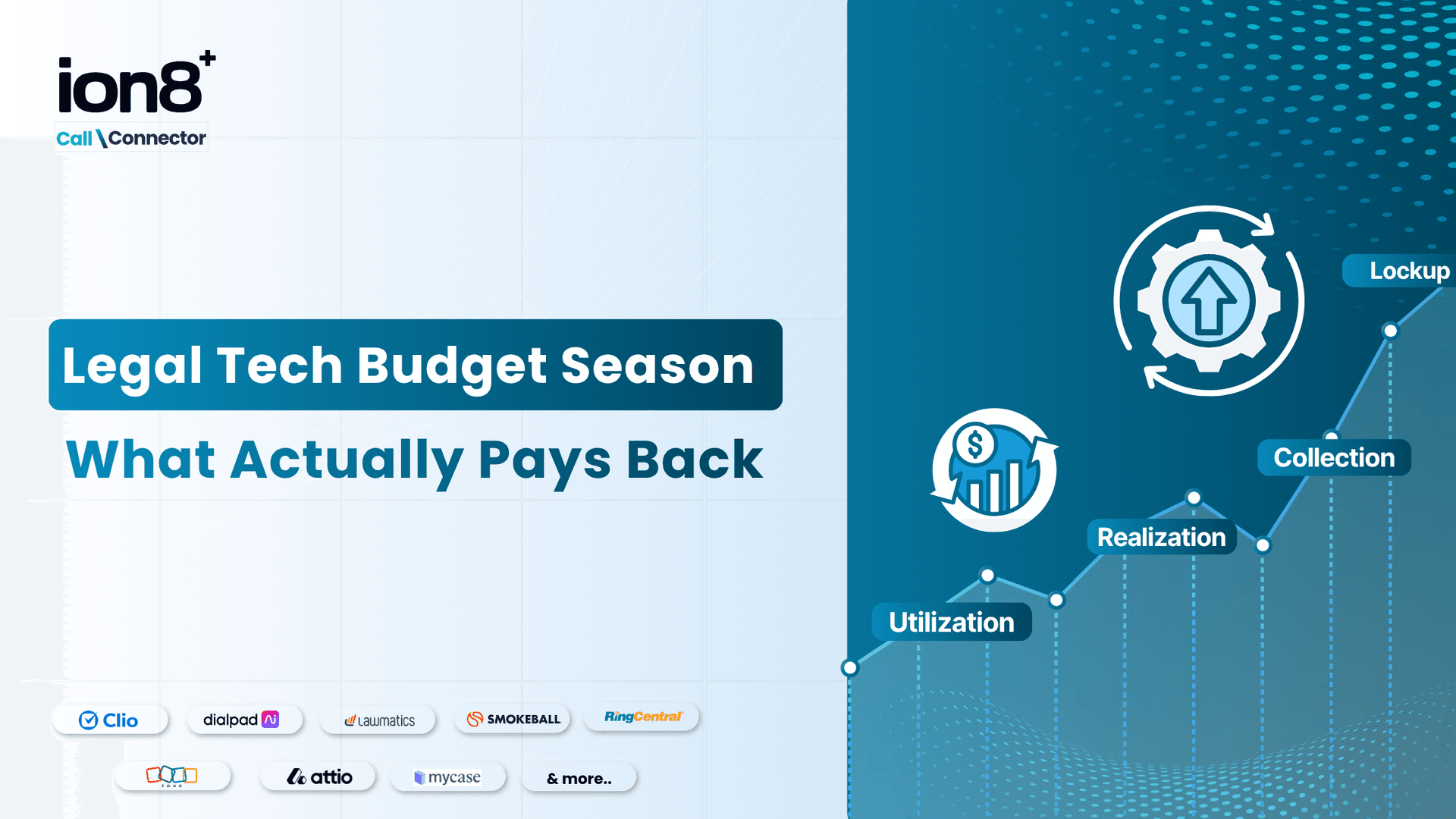
Every dollar of legal tech budget ultimately shows up, or doesn't, in one of four numbers Clio's own Legal Trends Report tracks industry-wide: utilization, realization, collection, and lockup. Mapping spend to these gaps, rather than to feature lists, is what turns a budget line item into a measurable return.
Utilization (currently 38% industry-wide): Clio's Legal Trends Report benchmarks show lawyers capture only 3.0 billable hours in an 8-hour day. Tools that reduce manual data entry and administrative drag directly target this number.
Realization (currently 88%): This measures how much billable work actually gets invoiced. Work that happens but never gets logged - a client call, a quick consultation- never has a chance to become an invoice, let alone get paid.
Collection (currently 93%): Invoiced work still has to get paid. Payment friction, unclear invoices, and slow follow-up all suppress this number regardless of how good the underlying billing was.
Lockup (currently 93 days median): The combined delay between work performed and cash actually received. Every gap above compounds into this one number, which is ultimately a cash flow problem, not just a billing problem.
Once spend is mapped to one of these four gaps, "did it pay back" becomes a specific question with a specific answer, not a subjective impression.
Where CallConnector.ai Fits in the Budget
CallConnector.ai is built specifically for the utilization and realization gaps above: the calls that happen but never make it into a bill. It automatically captures, transcribes, and logs every call, SMS, and fax directly into Clio Manage, Smokeball, etc., in real time, with no manual entry required.
That directly targets the mechanism behind a weak realization rate: work that happened but was never recorded can't be invoiced, no matter how good the firm's billing process otherwise is. For a firm evaluating this budget season's spend against the four-gap framework above, call logging is one of the more directly measurable categories; the before-and-after shows up in logged call volume and billed hours, not just a subjective sense of "things feel more organized."
Visit CallConnector.ai to see how automatic call logging closes this specific gap.
Practice Management Software: The Line Item Every Firm Already Has
Practice management software is usually the single largest legal tech line item in a firm's budget, and its ROI shows up primarily in the lockup number rather than utilization. By centralizing matter data, billing, and client communication in one system, the role Clio Manage plays for most firms already using it shortens the path between work performed and invoice sent.
Firms re-evaluating this spend during budget season should ask a narrower question than "do we like the software": does it currently reduce the number of days between billable work and an invoice going out? If that number hasn't moved, the tool isn't underperforming; it's likely just not being used to its full billing-cycle capability, which is a training and workflow question as much as a technology one.
How Should Firms Prioritize Legal Tech Spend This Budget Season?
Prioritizing legal tech spend starts with identifying which of the four gaps above is costing the firm the most, then funding the category that targets it directly, not the category with the most compelling demo.
- Pull your firm's actual utilization, realization, and collection numbers first. A vendor conversation before this step is a feature conversation, not a budget decision.
- Match each proposed purchase to one specific gap. If a tool can't be tied to utilization, realization, collection, or lockup, it's a convenience purchase, not an ROI purchase.
- Ask staff which existing tools already work well. The ABA's own data shows staff feedback outweighs vendor marketing in purchasing decisions; use that internally too.
- Recheck the number 90 days after any purchase. If the targeted gap hasn't moved, the tool isn't being used correctly, or it wasn't the right fix for that gap.
This turns budget season from a renewal exercise into an actual capital allocation decision, the same discipline behind treating any spend as an investment rather than a subscription to keep paying.
Make This the Budget Season Where Spend Pays Back
Legal tech budgets don't fail because firms spend too little; they fail because spend isn't mapped to anything measurable. Tying this year's purchases to utilization, realization, collection, or lockup turns budget season into an actual return-on-investment decision instead of a renewal list.
If call logging and billing capture are the gap costing your firm the most, visit CallConnector.ai to see how automatic call logging closes it.
Connectez-vous avec nous