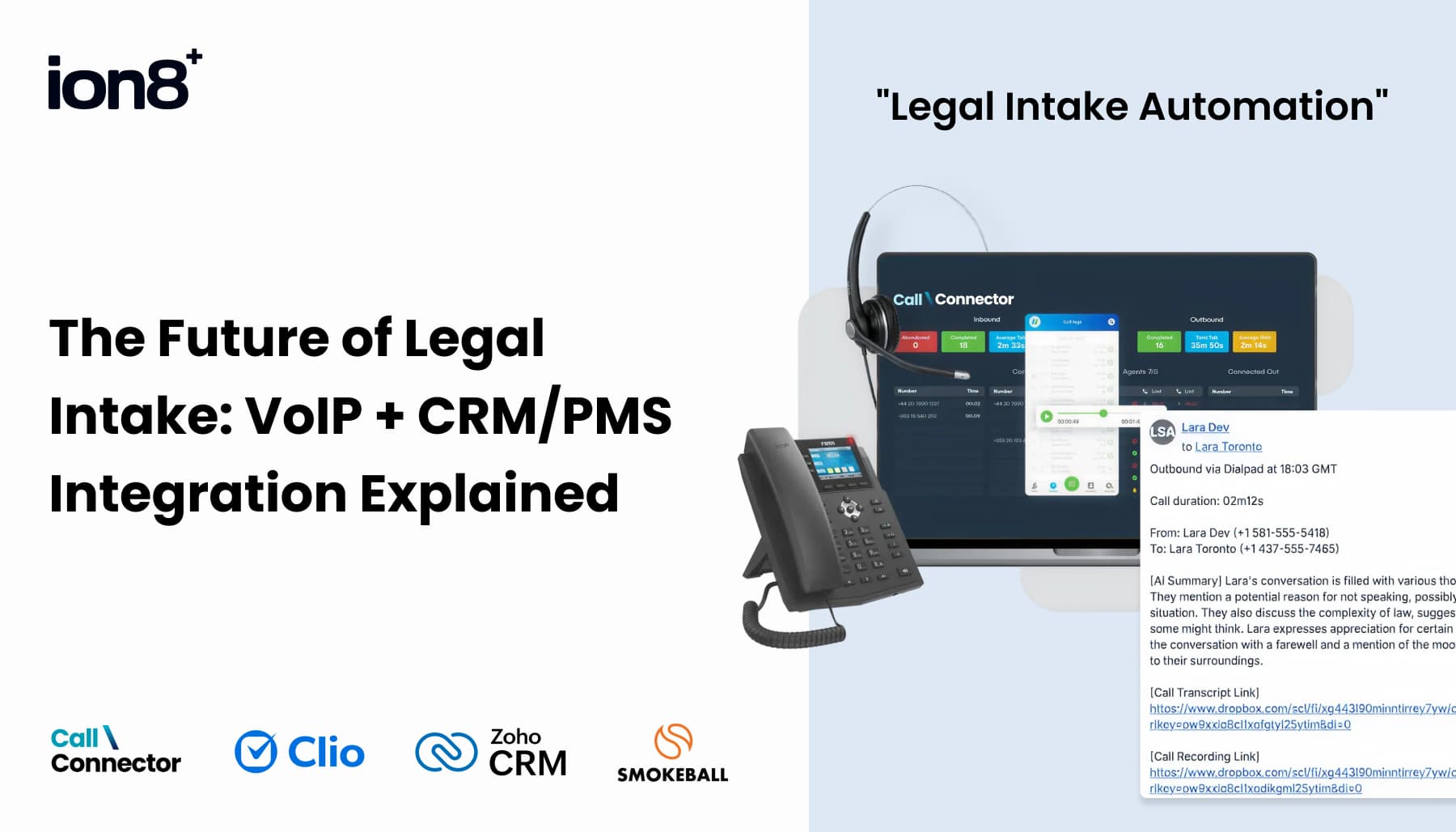
For law firms, the intake process is the first and most critical step in building a client relationship. From the moment a prospective client calls the office, the experience shapes their impression of the firm’s professionalism, efficiency, and trustworthiness.
But here’s the challenge: many firms still rely on fragmented tools to handle intake. A client calls through a VoIP system, staff jot down notes on paper or in an email, and that information is entered into the CRM or practice management system only later. The result? Missed details, slower response times, and lost opportunities.
The solution lies in integrating VoIP with CRM and Practice Management systems. Together, these tools create a streamlined, automated intake process that saves time, improves accuracy, and enhances client service. This integration represents the future of legal intake, one where technology ensures no lead slips through the cracks.
Why Legal Intake Matters More Than Ever
Clients are now faced with more options than ever. A poor intake experience, delayed callbacks, lost information, or inconsistent communication often leads prospects to look elsewhere.
A Clio study found that 79% of clients expect a response within 24 hours, and many will move on if they don’t hear back promptly. That means law firms must prioritize intake efficiency and responsiveness.
When VoIP and CRM work together, firms can ensure calls are captured instantly, client information is logged automatically, and follow-ups are prompt and personalized.
The Disconnect: VoIP Without CRM / PMS
VoIP systems have revolutionized law firm communications by making calls cheaper, more flexible, and mobile-friendly. However, VoIP alone doesn’t manage the data generated by those calls.
Here’s where firms struggle:
- Missed Opportunity Tracking: Calls come in, but if staff forget to log details in the CRM/PMS, potential clients are forgotten.
- Data Silos: Caller information stays in the VoIP system but doesn’t sync with client records.
- Manual Data Entry: Staff waste hours typing notes into the CRM after calls. 4.** Revenue leakage**: Consultations and billable intake calls often go untracked.
VoIP delivers the call, but not the business intelligence needed to convert that call into a paying client.
How VoIP + CRM/PMS Integration Works
When VoIP is integrated with a law firm’s CRM/PMS system, every incoming and outgoing call becomes part of a centralized client record.
Here’s what the process looks like:
- Caller Identification: When a prospective client calls, the CRM instantly pulls up existing client-matter records or creates a new lead profile.
- Automatic Call Logging: The call is recorded in the CRM with date, time, duration, and (if enabled) even a summary or transcription.
- Matter Association: Calls are linked to specific matters, ensuring intake staff capture context.
- Follow-Up Triggers: The CRM can automatically create tasks or reminders for attorneys to follow up.
- Analytics & Reporting: Firms gain insight into call volumes, response times, and intake conversion rates.
This level of automation eliminates manual data entry, reduces errors, and ensures consistent client experiences.
Benefits of VoIP + CRM/PMS Integration for Law Firms
- Faster Response Times: With client information instantly available, staff can provide informed, personalized service from the first call.
- Streamlined Intake Workflow: No more juggling between phone systems, sticky notes, and CRM/PMS. Intake teams handle everything from one dashboard.
- Better Conversion Rates: Automated reminders and task assignments ensure no prospective client falls through the cracks.
- Accurate Billing for Consultations: Initial intake calls that are billable can be logged and tracked automatically, reducing revenue leakage.
- Improved Client Experience: Prospects feel valued when firms respond quickly and professionally — a major differentiator in a competitive market.
- Searchability: Thanks to the summary or transcript features, telephone calls now become as searchable as emails, notes, or documents..
The Competitive Advantage
Consider two competing firms, Firm A uses VoIP alone. When a client calls, the staff writes notes on paper. Some get entered into the CRM, but others are misplaced or delayed. Follow-ups are inconsistent.
Firm B integrates VoIP with its CRM. Every call is logged instantly, leads are automatically assigned, and attorneys receive follow-up reminders. The firm can even track intake conversion rates in reports.
Firm B definitely wins more clients, responds faster, and captures more billable time, all because of a straightforward integration.
The Role of AI in Legal Intake
The next evolution of VoIP + CRM integration is the addition of AI-powered tools, such as CallConnector.ai. This combination of VoIP, CRM/PMS, and Call Connector creates a powerful triad that ensures your law firm not only captures data but also generates insights to improve client acquisition strategies.
Implementation Considerations for Law Firms
Adopting VoIP + CRM/PMS integration doesn’t have to be overwhelming. Here are a few best practices:
- Choose the right CRM/PMS: Look for one designed for legal practice management.
- Ensure compatibility: Verify that the VoIP system integrates natively with your CRM or through a connector.
- Train intake staff: Even with automation, staff must understand how to maximize the system’s features.
- Integrate Call Connector: Begin with core features like call logging and follow-up tasks, then expand to AI-powered tools.
VoIP and CRM/PMS integration is no longer optional for firms that want to grow; these tools streamline client onboarding, improve accuracy, and deliver faster response times, all while protecting revenue. By embracing this, law firms position themselves for tomorrow’s challenges: more demanding clients, tighter competition, and the growing role of AI in legal services.
Ready to modernize your intake process? Explore how VoIP + CRM/PMS integration can help your law firm capture more leads, streamline billing, and deliver a client experience that sets you apart.
Connect with us