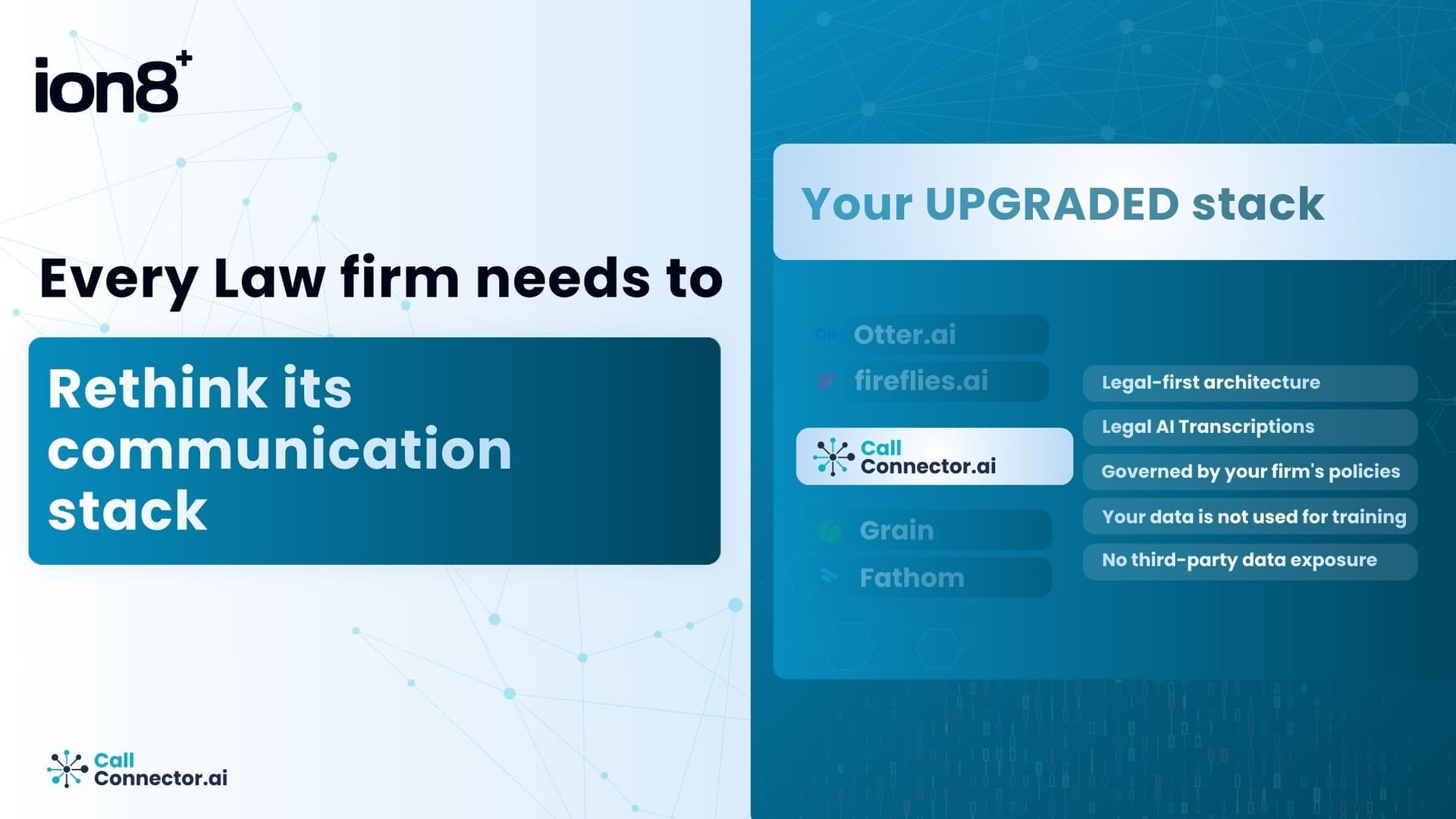
A federal class action against the world's most popular AI note-taker has put the entire category under scrutiny. Here's what it means for your practice, and what our purpose-built alternative, CallConnector.ai, looks like.
On August 15, 2025, a San Jacinto resident named Justin Brewer filed a lawsuit against Otter.ai. Three more followed within the month. By October, a federal judge in San Jose had consolidated all four into a single class action: In re Otter.ai Privacy Litigation, Case No. 5:25-cv-06911, Northern District of California.
The case is still working through the courts. No court has yet ruled that Otter.ai's practices are unlawful. But the litigation has forced a federal examination of whether a consumer AI notetaker bot can legally sit in on your meetings without the explicit consent of every participant.
For law firms using general-purpose AI recording tools, that question is existential.
What The Lawsuit Actually Alleges
The consolidated complaint raises four distinct categories, each one a separate legal exposure, and directly relevant to how law firms handle client communications.
-
Unauthorized recording: The headline claims Otter.ai's bot joined meetings on Zoom, Google Meet, and Microsoft Teams and recorded them without the consent of all participants. The tool only sought permission from the meeting host; non-users had no mechanism to opt out, no meaningful notice, and no recourse. For legal proceedings, both parties must affirmatively consent before a private conversation can be recorded.
-
Indefinite storage with no retention policy: The complaint alleges that Otter retained those recordings indefinitely, and provided no disclosure to participants about how long their conversations would be stored, or under what conditions they might be accessed, shared, or deleted.
-
Using private conversations to train AI models: The complaint alleges that Otter used the content of recorded calls to train its automatic speech recognition and machine learning models. Justin Brewer, the lead plaintiff, states he was never informed that his words would be used for model training.
-
Biometric data capture without consent: A separate suit adds a fourth dimension: Otter's system captures and stores voiceprints from every meeting participant.
Otter.ai filed a motion stating that no interception occurred and that plaintiffs have not made a plausible case on the core legal elements. That argument is now before the court.
Why Law Firms Face A Different Kind Of Risk
Law firms face a compounded problem that most other industries do not. The allegations above map almost perfectly onto the obligations your firm already owes its clients.
These are not hypothetical risks; they are fact patterns that bar associations and legal ethics bodies have been quietly flagging for two years. The Otter.ai litigation has made them impossible to ignore.
There is also a reputational dimension that goes beyond legal liability. Your clients are sophisticated enough to ask whether their calls are being recorded, by whom, and for what purpose. A general-purpose consumer notetaker, designed for sales teams, students, and journalists, is a difficult tool to defend in a client meeting when the question comes up.
The Design Problem No General-Purpose Tool Can Solve
The Otter.ai lawsuit at its core is not about one company's bad decisions. It is about a category of product that was designed without legal practices in mind.
Consumer AI notetakers were built for convenience. Their default consent models reflect that priority. A general-purpose tool will always have consent flows designed for general purposes. Data retention policies built for general purposes. Model training defaults set for general purposes.
The legal profession's requirements (privilege, confidentiality, chain of custody, ethical obligations to clients) are not edge cases that can be addressed with an enterprise tier add-on. They require a system designed for legal, and that's what we have built with CallConnector.ai.
What Purpose-Built Looks Like
CallConnector.ai was not built to later add legal integrations. It was built as a legal-practice infrastructure that transcribes, logs, and documents, because that is the workflow that law firms actually run.
Consent by Design - Two Modes, Both Deliberate
CallConnector.ai handles phone calls and video meetings differently, and that distinction matters for compliance. For phone calls, CallConnector.ai operates at the telephony infrastructure layer; recording happens through the infrastructure your firm already controls, governed by your firm's consent disclosures.
For video meetings, CallConnector.ai does join as a named participant: "ion8 Call Connector." But critically, it does not auto-join. The host receives an explicit prompt, "Someone wants to join this call", and must actively click Admit before CallConnector enters. That is a deliberate, affirmative host action.
Data that stays where you put it
One of the four allegations against Otter.ai is that recordings are retained indefinitely on its servers, with no meaningful retention schedule disclosed to participants. CallConnector.ai architecture makes that scenario structurally impossible. Transcripts, call summaries, and billing records flow directly into your practice management system (Clio Manage, Smokeball, Filevine, Lawmatics, etc). Your data is governed by your firm's retention policies, not by a consumer product's defaults.
CallConnector.ai does not use your call data to train shared models. The content of your client calls belongs only to you.
Autonomous, not intrusive
The product's principle is straightforward: all you have to do is take the call. For phone calls, CallConnector.ai works entirely in the background. For video meetings, the host admits a clearly named participant once, and everything else - transcription, billing, filing- happens automatically from there.
Billable time that actually gets captured
Beyond compliance, there is a revenue argument. Research consistently finds that lawyers capture only 60–80% of their actual billable time through manual logging. Every call that goes unrecorded is a call that goes unbilled. CallConnector.ai closes that gap automatically as its primary function.

Why CallConnector.ai is the solution
The responsible move is to replace risk entirely, not manage it. That means switching from a general-purpose AI notetaker to a platform built from the ground up for legal practices. That platform is CallConnector.ai.
Eliminate the auto-join problem entirely
CallConnector.ai works differently depending on the call type. That single step is the difference between passive acceptance and affirmative consent, and it is exactly the distinction that matters under the two-party consent statutes.
Keep your data inside your firm
When a call ends, CallConnector.ai automatically pushes the transcript, call summary, and billing entry directly into your practice management system. Your data lives exactly where your matter records belong.
Stop losing billable time
The compliance argument for switching is compelling. The financial argument is just as strong. A legal-industry source says waiting until the end of the day to record time can cost 10%–15% of potential billable hours, and waiting 24 hours or a week can lead to even larger losses. Every call that goes unrecorded is revenue that evaporates. CallConnector.ai captures and logs every call automatically: the exact duration, the matter it belongs to, the billing entry.
Get running immediately
CallConnector.ai integrates with the tools your firm already uses. If you are on Clio, Smokeball, or Filevine for matter management, and RingCentral, or Dialpad, for communications, you can be live without a rip-and-replace project. The setup is designed for firms that cannot afford months of implementation, because your calls are happening today, and every one that goes uncaptured is a call that goes unbilled.
The bottom line:
CallConnector.ai is the intelligent middleware your practice should have been running on already.
The case against Otter.ai may resolve in months or take years. But the underlying question, whether consumer AI tools meet the consent and confidentiality standards that legal practices require, will not go away with a verdict. It will intensify as AI becomes more embedded in how law is practised. The firms that answer that question now, with purpose-built infrastructure, are the ones that will not have to answer it under pressure later.
Learn more about CallConnector.ai and start capturing calls the right way today.
Connect with us