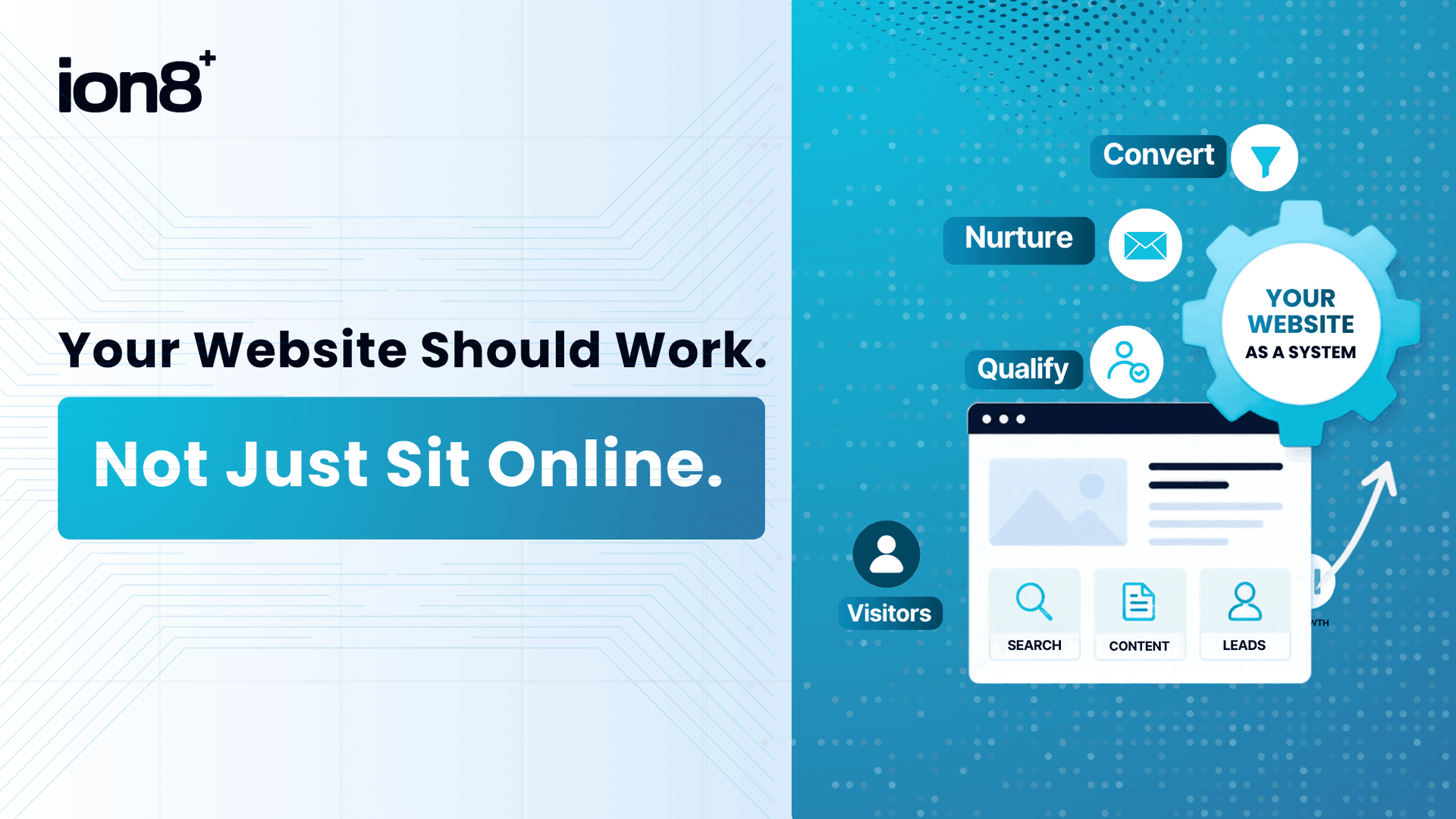
When many business owners think about their website, they picture a digital brochure, a static collection of pages that describe products, services, or brand. But in an always-on, search-driven world, a B2B website strategy built around "being online" quietly leaks revenue every day it goes unchanged. Design your website as a system instead, and it becomes a scalable growth engine that attracts, qualifies, converts, and nurtures customers on its own.
In this article, we break down what it actually means to treat your website as a system instead of a brochure, the core components that make one work, how that structure supports SEO, AEO, and GEO together, and the practical steps to start the shift without a full rebuild.
What Does It Actually Mean to Treat Your Website as a System?
A system-driven website performs specific, measurable jobs across the entire customer journey instead of just looking good and being online. It's dynamic and integrated with your business processes; it captures leads, nurtures prospects, connects to your CRM, and reports on real user behavior instead of just displaying information.
Treating your website as a system means thinking in inputs, processes, outputs, and feedback loops. That mindset shift matters for SEO, AEO, and GEO alike: instead of optimizing isolated pages, you build an interconnected, goal-driven structure where every page has a role and supports the entire funnel.
##Why Do Brochure Websites Fall Short?
Brochure-style websites share a few predictable traits: a generic homepage focused on "we" instead of "you," surface-level content that skips real buyer questions, and no conversion path beyond a basic contact form. They might look polished, but they aren't built to do the job.
Specifically, brochure sites tend to fail at these functions:
- Capturing and nurturing leads beyond a single generic contact form.
- Educating buyers who are at different stages of the buying journey.
- Supporting your sales team with relevant, linkable content assets.
- Ranking for intent-driven keywords that actually generate revenue.
Weak internal linking compounds the problem: when pages aren't connected around clear topics, search engines and AI answer engines alike struggle to understand what your business is actually an authority on.
The Core Components of a System-Driven Website
Turning a website into a system means getting a few core building blocks working together, not in isolation.
-
Strategic Site Architecture and Content Hubs: A system-driven website is organized around topics and intent, built as content hubs where a pillar page targets a broad, high-intent problem and supporting cluster pages go deep on subtopics, FAQs, and use cases. Internal links connect the cluster so both visitors and search engines can move between levels of detail.
-
Clear, Intentional Conversion Paths: Every important page should lead to a logical next step, whether that's downloading a resource, booking a consultation, or viewing a case study. Instead of a single "Contact us" button, build multiple context-aware CTAs matched to funnel stage:
- Top-of-funnel pages inviting readers to download a guide or join a newsletter.
- Middle-of-funnel pages offering webinars, comparison guides, or case studies.
- Bottom-of-funnel pages pushing toward demos, pricing, or consultation calls.
The result behaves like a funnel, not a billboard.
- Integrated Analytics and Feedback Loops: A system only improves if it has feedback. At minimum, track traffic sources by channel, on-page behavior like scroll depth and form completions, conversion rates for key pages, and the search queries actually driving organic traffic. ion8's own Attribution Dashboard is built for exactly this, tying page-level behavior back to pipeline instead of leaving it in disconnected reports.
That data answers the questions that matter: which pages attract high-intent visitors, where people drop off, and which topics bring in qualified leads versus unqualified traffic. Once you know the answers, you refine the system continuously instead of redesigning the whole site every few years.
How Does a Website System Support SEO, AEO, and GEO?
A website built as a system doesn't just rank better in classic search; it also gets surfaced more often in AI answer engines and cited more often in generative AI responses, because all three reward the same underlying structure: clear topics, clean internal linking, and content that answers a specific question directly.
Stronger Topical Authority (SEO). Structured content hubs with strong interlinking send clear signals about your expertise, showing search engines which topics you cover deeply and how your pages relate to each other. That can meaningfully improve rankings for competitive terms over time and win the long-tail searches that convert better.
Better User Experience and Engagement (SEO). Because a website system is built around user journeys, visitors find direct answers instead of generic marketing copy, move smoothly from high-level explanations to detailed resources, and get CTAs matched to where they actually are. Engagement metrics like time on page, pages per session, and conversions tend to improve when structure matches intent, which reinforces SEO performance further.
Measurable Impact on Pipeline (SEO). A system lets you attribute leads and revenue to specific pages and paths: "visitors who land on our comparison page are 3x more likely to book a demo," for instance. You can double down on what works and stop funding what doesn't.
Visibility in Answer Engines (AEO). B2B buying research has already moved into AI chatbots: 51% of B2B software buyers now begin vendor research in an AI chatbot, up from 29% in April 2025, and 73% use AI tools somewhere in their research process, according to G2's March 2026 data and the Pedowitz Group. Gartner forecasts 25% of organic search traffic will shift to AI chatbots by 2026. Content that's already structured into clear, question-answering hub-and-cluster pages is inherently easier for answer engines to extract and cite - no separate AEO checklist required.
Citation in Generative Engines (GEO). Google AI Overviews now appear on 48% of all queries, up from 31% in February 2025, and 46.5% of the URLs cited in those overviews rank outside the top 50 organically - meaning structure and clarity can earn citations even without a top classic ranking. That citation matters commercially: AI-referred visitors convert at roughly 4.4 times the rate of traditional organic visitors, per Semrush. A pillar-and-cluster structure with direct, extractable answers is the same structure that earns these citations.
Steps to Transform Your Website From Brochure to System
You don't have to rebuild your entire site to start thinking like a systems designer. Begin with a few practical moves.
-
Define Your Primary Journeys: Map the key journeys your website should support: problem-aware to discovery call, researching solutions to starting a trial, existing customer to expanding into a new service. For each journey, identify which pages exist and where the gaps sit between awareness, consideration, and decision.
-
Audit Your Content and Structure: Review every page against two questions: does it have a clear job to do, and does it lead to a logical next step? Group content into themes, identify potential content hubs, add internal links connecting related pages, and adjust titles and headings to reflect real search intent rather than brand slogans.
-
Build or Refine Your Conversion Offers: If "Contact us" is your only offer, you're leaving opportunity on the table. Create offers matched to readiness:
- Guides, checklists, and email courses for early-stage visitors.
- Webinars, tools, and comparison sheets for active evaluators.
- Demos, consultations, and assessments for ready-to-buy prospects.
Integrate these into key pages with clear CTAs and simple forms, then track conversions so you can iterate.
- Commit to Continuous Improvement: A system is never "done." Schedule regular reviews to update high-performing content, retire or merge low-value pages, improve page speed and accessibility, and test new headlines and CTAs on critical pages.
Turning Your Website Into a Growth Engine
A brochure website looks fine and does very little. A system-driven website works around the clock, attracting the right visitors, answering their real questions, and moving them toward a decision, whether they arrive through a search engine, an AI chatbot, or a generative AI answer.
At ion8, we design websites that behave like systems: structured content hubs, intentional conversion paths, and integrated analytics working together instead of in isolation. Contact ion8 to learn how we can help your website start generating revenue instead of just sitting online.
Connect with us